Rudolph Taylor is an artist and printmaker whose work expands on how classical representation can be used to show an increasingly global and multicultural world.
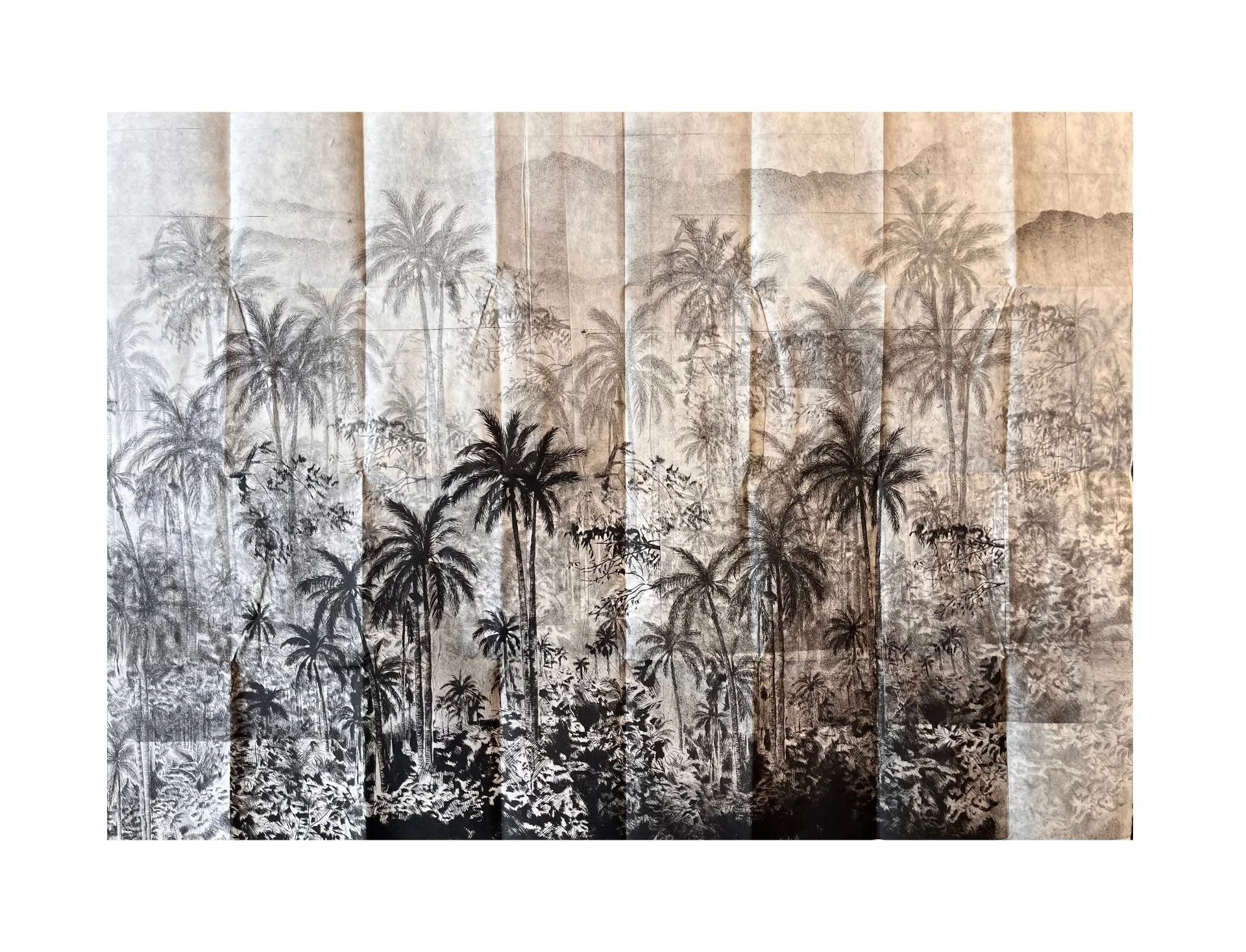
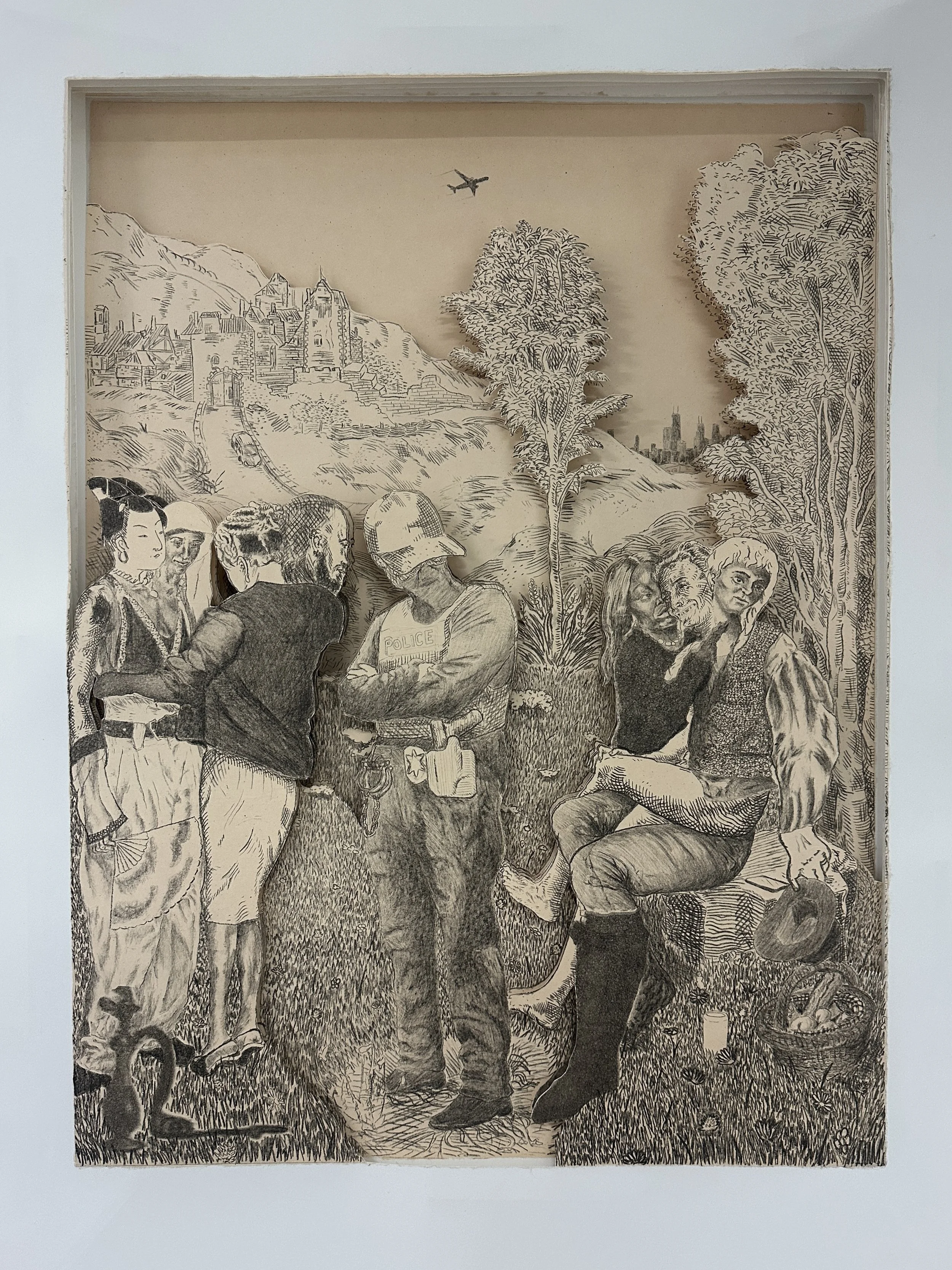
Through the use of archives and his skills as collaborative printmaker, Rudolph uses collage and drawing to reinterpret classical western art to reflect the world today. Mixing up bodies with clothing and objects from across the world and centuries he depicts the complexity of being multiracial, while also creating a space in which these individuals can exist in the fullness of their multifaceted identities.
Rudolph utilises lithography as a way to draw on the history of reproduction within printmaking, but through the manipulation of the imagery he creates scenes and environments outside of their time. While from a distance one might feel the work is recognisable, upon closer observation the complexities of Rudolph’s world reveal themselves, subverting the original expectations. Much like navigating the world with a mixed body, Rudolph’s work invokes a sense of familiarity, an illusion that is shattered upon close inspection
Born and raised in Chicago, IL, USA, Rudolph would go on to receive his BFA in Studio Arts from Syracuse University in 2019, where he concentrated in printmaking and received the Bruce Manwaring Printmakers Award. It was there he started collaborating with artist to assist in the making of new unique prints of their work. He then went on to complete the Tamarind Printer Training program in 2022, and soon after worked as a collaborative printmaker at Paulson Fontaine Press in Berkeley, CA. While in Berkeley he began teaching lithography workshops at the Kala Institute and taught print classes at the California College of Art. He went on to complete his MA in Print at the Royal College of Art in 2025 and now works as a print tutor at the Royal Academy Schools.
Rudolph has exhibited work all over the United States and in the UK and has works in collections such as the Lake Effect Editions archive, Tamarind Institute archives, and the British Museum.
Rudolph Taylor is an artist and printmaker whose work expands on how classical representation can be used to show an increasingly global and multicultural world.
Through the use of archives and his skills as collaborative printmaker, Rudolph uses collage and drawing to reinterpret classical western art to reflect the world today. Mixing up bodies with clothing and objects from across the world and centuries he depicts the complexity of being multiracial, while also creating a space in which these individuals can exist in the fullness of their multifaceted identities.
Rudolph utilises lithography as a way to draw on the history of reproduction within printmaking, but through the manipulation of the imagery he creates scenes and environments outside of their time. While from a distance one might feel the work is recognisable, upon closer observation the complexities of Rudolph’s world reveal themselves, subverting the original expectations. Much like navigating the world with a mixed body, Rudolph’s work invokes a sense of familiarity, an illusion that is shattered upon close inspection
Born and raised in Chicago, IL, USA, Rudolph would go on to receive his BFA in Studio Arts from Syracuse University in 2019, where he concentrated in printmaking and received the Bruce Manwaring Printmakers Award. It was there he started collaborating with artist to assist in the making of new unique prints of their work. He then went on to complete the Tamarind Printer Training program in 2022, and soon after worked as a collaborative printmaker at Paulson Fontaine Press in Berkeley, CA. While in Berkeley he began teaching lithography workshops at the Kala Institute and taught print classes at the California College of Art. He went on to complete his MA in Print at the Royal College of Art in 2025 and now works as a print tutor at the Royal Academy Schools.
Rudolph has exhibited work all over the United States and in the UK and has works in collections such as the Lake Effect Editions archive, Tamarind Institute archives, and the British Museum.