
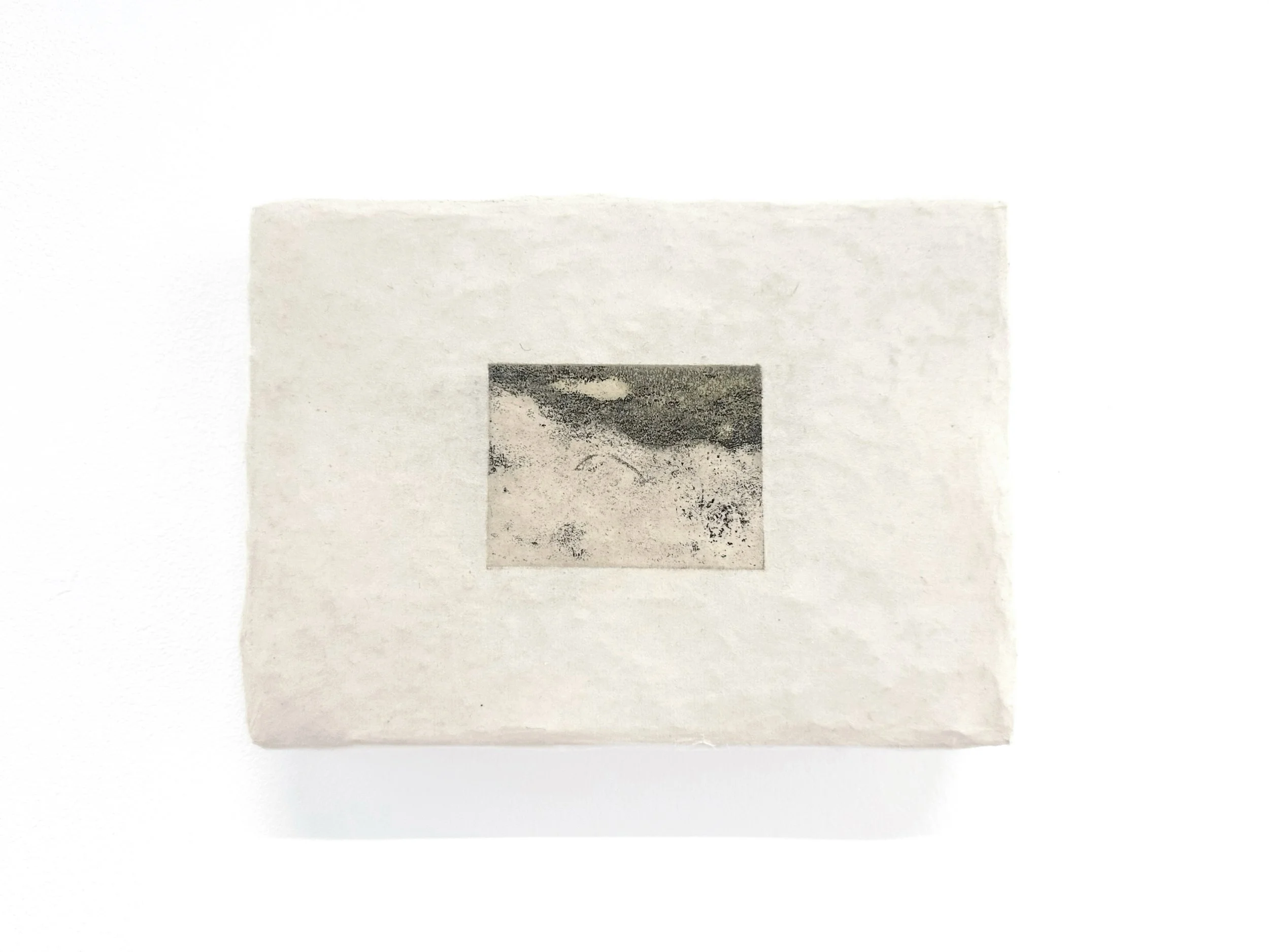
Snow removes certainty. It softens borders, buries landmarks, and allows different places to resemble one another. Grace Fang returns to this condition to construct landscapes that exist beyond geography. The landscapes in her work are assembled from remembered places, imagined terrains, and material traces that never fully resolve into a single location.
Having lived between China, the United States, and the United Kingdom, she became attentive to how unstable our sense of place can be. Over time, however, her work shifted away from describing this experience itself toward a quieter question: what if uncertainty is not simply a temporary stage before clarity, but a condition that does not ask to be resolved at all?
Working primarily through printmaking, Fang has found a process that allows her to remain within this question. Printmaking resists complete control. Each plate, impression, transfer, and layer alters the image in ways that cannot be entirely anticipated. Rather than seeking to eliminate these shifts, she works with them. Meaning emerges gradually through negotiation with the material, where thinking is inseparable from making and decisions remain open to revision.
Snow, solitary trees, and open fields recur throughout her work, not as symbols, but as conditions. They are spaces in which images resist settling into fixed meanings, much as memory resists becoming entirely stable. What interests her is not uncertainty itself, but the possibility that a landscape, an image, or a way of understanding the world might remain open without becoming incomplete.
Rather than guiding viewers towards certainty, she hopes the work offers a space where meaning can continue to unfold. Since nothing needs to settle too quickly, remaining open becomes another way of being with the world.
Snow removes certainty. It softens borders, buries landmarks, and allows different places to resemble one another. Grace Fang returns to this condition to construct landscapes that exist beyond geography. The landscapes in her work are assembled from remembered places, imagined terrains, and material traces that never fully resolve into a single location.
Having lived between China, the United States, and the United Kingdom, she became attentive to how unstable our sense of place can be. Over time, however, her work shifted away from describing this experience itself toward a quieter question: what if uncertainty is not simply a temporary stage before clarity, but a condition that does not ask to be resolved at all?
Working primarily through printmaking, Fang has found a process that allows her to remain within this question. Printmaking resists complete control. Each plate, impression, transfer, and layer alters the image in ways that cannot be entirely anticipated. Rather than seeking to eliminate these shifts, she works with them. Meaning emerges gradually through negotiation with the material, where thinking is inseparable from making and decisions remain open to revision.
Snow, solitary trees, and open fields recur throughout her work, not as symbols, but as conditions. They are spaces in which images resist settling into fixed meanings, much as memory resists becoming entirely stable. What interests her is not uncertainty itself, but the possibility that a landscape, an image, or a way of understanding the world might remain open without becoming incomplete.
Rather than guiding viewers towards certainty, she hopes the work offers a space where meaning can continue to unfold. Since nothing needs to settle too quickly, remaining open becomes another way of being with the world.