![121445-0-U59659-F.jpg]() Image 1 of 1
Image 1 of 1
John Fass | Witness II
Enquire
Cyanotype On Paper
Edition of
Dimensions (WxH): 53 x 63cm
John’s work explorses the encounter between ancient permanence and photographic impermanence. Using a nineteenth-century printing process, I've captured standing stones—monuments that have endured for millennia. The cyanotype process enacts a kind of alchemy through sunlight, chemistry, and paper. What emerges is neither purely documentary nor entirely abstract, but something that hovers between memory and material.
These stones have stood for thousands of years, silent witnesses to ritual and season. The cyanotype, by contrast, is fragile—light-sensitive, prone to fading. Yet in this tension between the enduring and the fugitive, something resonates: both stone and photograph are markers, ways of saying this matters, remember this.
The traces of process, drips and scratches, transform the familiar into something uncanny, rendering the stones as if seen through water or recalled from dream. They stand isolated in their blue worlds, monumental yet strangely vulnerable, ancient yet somehow newly made.
These works meditate on what persists and what dissolves—in time, in memory, in the chemical reactions that fix an image, in the slow weathering that marks stone. They ask what it means to witness, to mark, to remain.
Get notified by email when this product is in stock.
Cyanotype On Paper
Edition of
Dimensions (WxH): 53 x 63cm
John’s work explorses the encounter between ancient permanence and photographic impermanence. Using a nineteenth-century printing process, I've captured standing stones—monuments that have endured for millennia. The cyanotype process enacts a kind of alchemy through sunlight, chemistry, and paper. What emerges is neither purely documentary nor entirely abstract, but something that hovers between memory and material.
These stones have stood for thousands of years, silent witnesses to ritual and season. The cyanotype, by contrast, is fragile—light-sensitive, prone to fading. Yet in this tension between the enduring and the fugitive, something resonates: both stone and photograph are markers, ways of saying this matters, remember this.
The traces of process, drips and scratches, transform the familiar into something uncanny, rendering the stones as if seen through water or recalled from dream. They stand isolated in their blue worlds, monumental yet strangely vulnerable, ancient yet somehow newly made.
These works meditate on what persists and what dissolves—in time, in memory, in the chemical reactions that fix an image, in the slow weathering that marks stone. They ask what it means to witness, to mark, to remain.

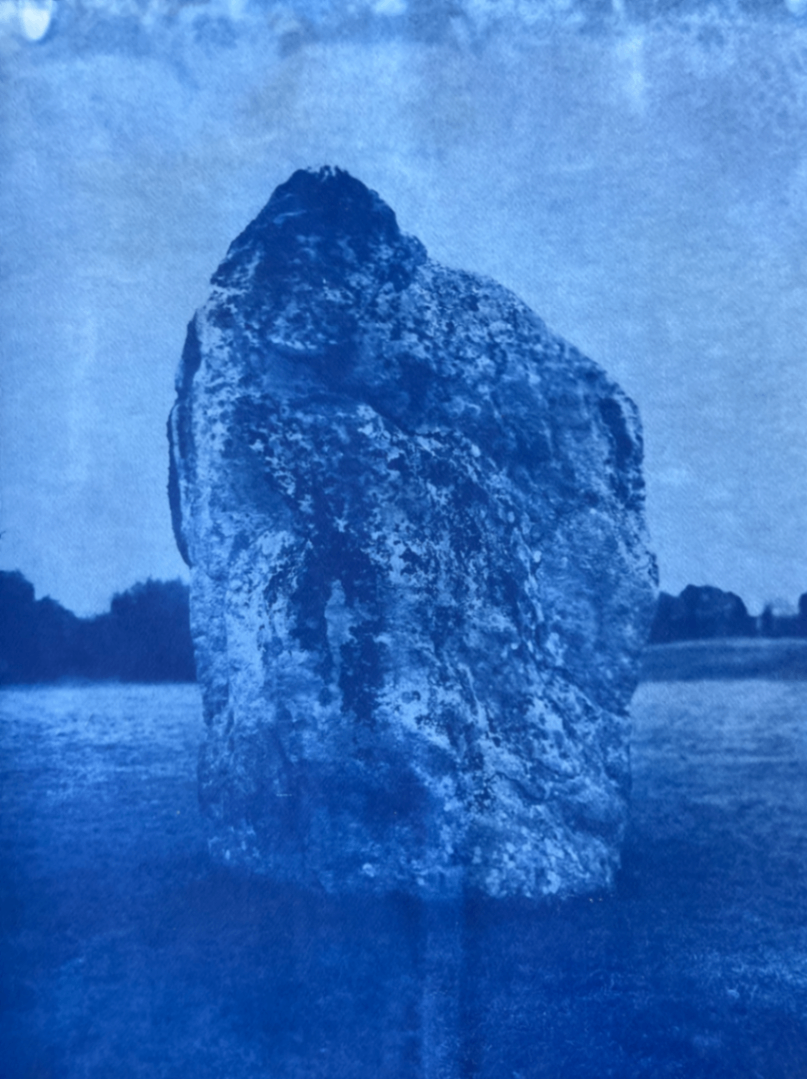 Image 1 of 1