Woodcut Print Edition of 11 Dimensions (WxH): 103 x 140cm
Malav Padariya’s practice explores the relationship between material, perception, and image construction through the expanded language of relief printmaking. Working primarily with large-scale woodcuts carved into birch plywood, he is driven by a fascination with creating highly realistic images using one of printmaking’s most physically demanding mediums. Rather than concealing the evidence of carving, Padariya embraces the natural grain of the wood as an essential visual language. Each cut responds to the direction and character of the grain, allowing the material itself to generate the marks that construct the image.
Drawing inspiration from architecture, historical monuments, and the built environment, Padariya investigates how structures embody cultural memory and function as systems of visual information. His compositions are built through dense accumulations of grain-responsive marks that operate like pixels—fragmenting into abstract textures at close range and resolving into detailed forms from a distance.
By foregrounding the physical act of carving and the inherent qualities of wood, Padariya challenges conventional understandings of relief printmaking as a purely reproductive medium. His work demonstrates how realism emerges not despite the material’s constraints, but through them, proposing the woodcut as a site where process, material intelligence, and perception become inseparable.
Get notified by email when this product is in stock.
Woodcut Print Edition of 11 Dimensions (WxH): 103 x 140cm
Malav Padariya’s practice explores the relationship between material, perception, and image construction through the expanded language of relief printmaking. Working primarily with large-scale woodcuts carved into birch plywood, he is driven by a fascination with creating highly realistic images using one of printmaking’s most physically demanding mediums. Rather than concealing the evidence of carving, Padariya embraces the natural grain of the wood as an essential visual language. Each cut responds to the direction and character of the grain, allowing the material itself to generate the marks that construct the image.
Drawing inspiration from architecture, historical monuments, and the built environment, Padariya investigates how structures embody cultural memory and function as systems of visual information. His compositions are built through dense accumulations of grain-responsive marks that operate like pixels—fragmenting into abstract textures at close range and resolving into detailed forms from a distance.
By foregrounding the physical act of carving and the inherent qualities of wood, Padariya challenges conventional understandings of relief printmaking as a purely reproductive medium. His work demonstrates how realism emerges not despite the material’s constraints, but through them, proposing the woodcut as a site where process, material intelligence, and perception become inseparable.

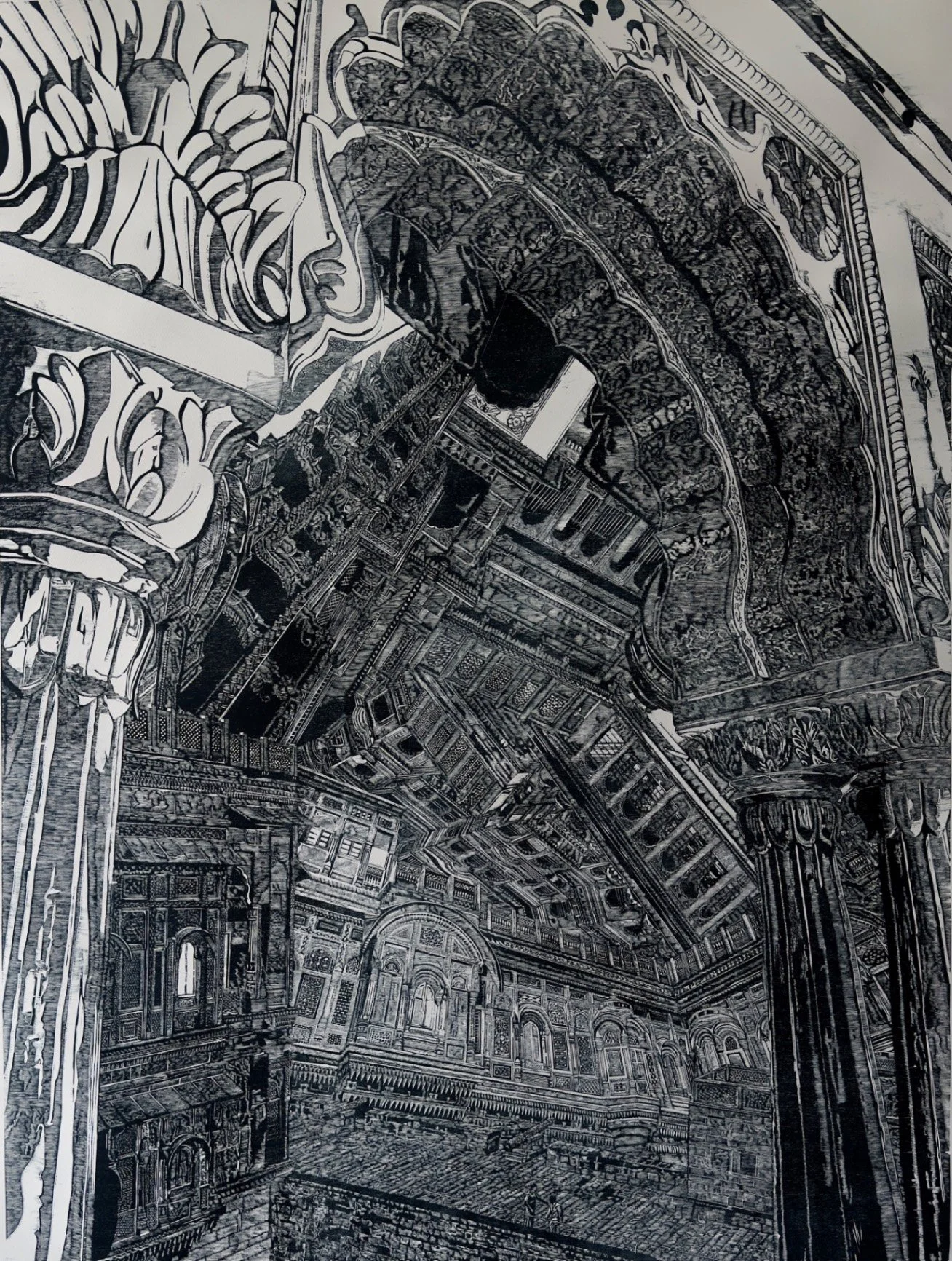 Image 1 of 1