
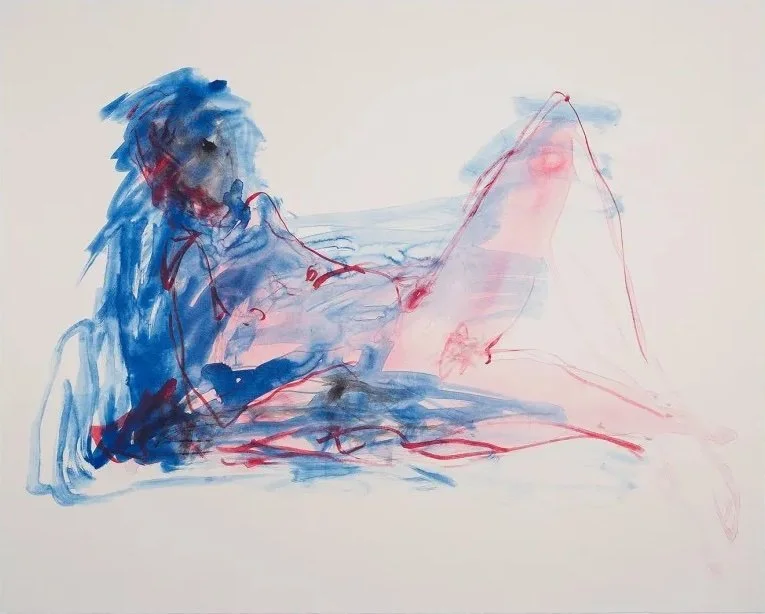
Lithograph
Lithography is a planographic printmaking process based on the principle that grease and water repel one another. The artist draws directly onto a flat limestone block or specially prepared metal plate using a greasy crayon, pencil, or liquid ink. Unlike relief or intaglio processes, the surface remains entirely flat; the image is created through chemical interaction rather than carving or incising into the material.
Once the drawing is complete, the surface is treated with a chemical solution that fixes the greasy marks and prepares the non-image areas to attract water. When the stone or plate is dampened and ink is rolled across it, the ink adheres only to the drawn areas and is repelled by the wet surface. Paper is then placed on top and passed through a press under steady pressure, transferring the inked image to the sheet.
Because the process closely follows the artist’s original hand, lithography is often valued for its ability to capture subtle tonal shifts, fluid lines, and the immediacy of drawing. The surface can register delicate gradations as well as bold graphic forms, allowing for a wide expressive range. Multiple stones or plates may be used to build up layers of colour in more complex works.
Lithography does not leave a carved impression in the plate itself, and the printed surface tends to feel smooth and even. Its defining qualities lie in the balance between precision and spontaneity: the final print retains the character of the artist’s mark while benefiting from the consistency and repeatability of the printing process.
-
The image is drawn onto a flat stone or plate.
Chemical processes define ink-receptive areas.
Ink adheres only to the drawn surface.
Paper is pressed against the plate to transfer the image.
-
Fluid, painterly marks.
Broad tonal range.
Can closely resemble drawing.
-
Stones and plates are relatively durable.
Impressions remain consistent across the edition.
Edition size is typically predetermined by the artist.
-
Defined by declared edition size.
Stones are often grained down after printing.
Smaller editions circulate less widely.