
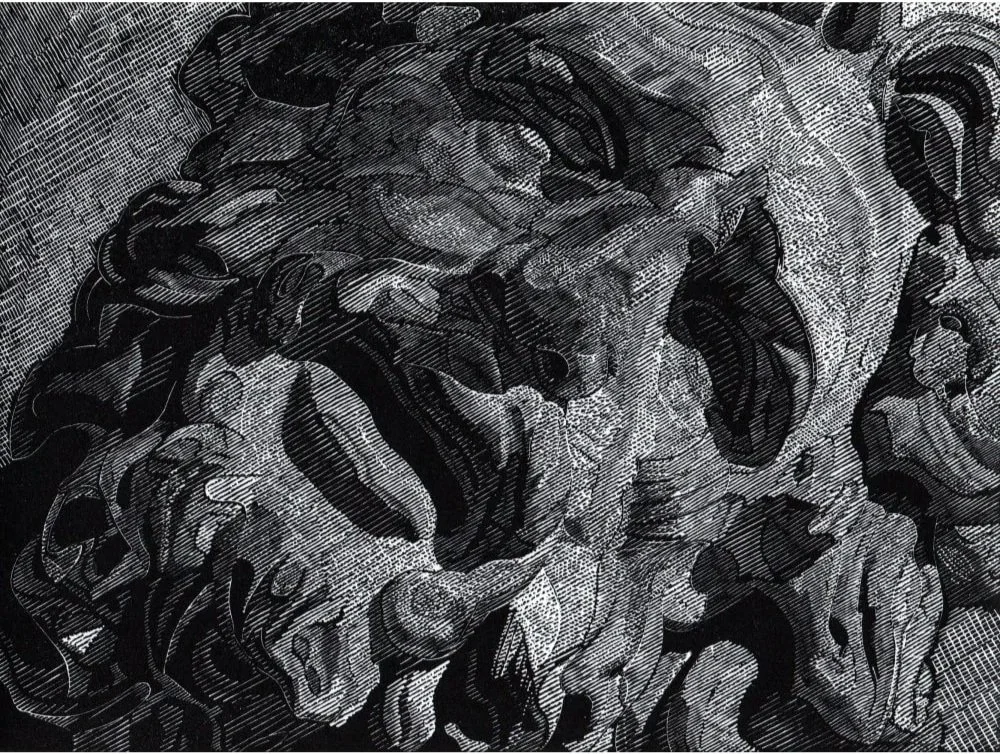
WOOD Engraving
Wood engraving is a relief printmaking process in which an image is cut into the end grain of a dense hardwood block, most commonly boxwood. Unlike woodcut, where the artist typically works along the plank surface, wood engraving is carved across tightly packed fibres, allowing for exceptionally fine lines and intricate detail.
The artist uses small, precise tools to incise the design into the smooth, polished surface, removing the areas that are not intended to print. The raised surface is then inked, and paper is placed on top and printed either by hand or with a press. The pressure transfers the ink from the engraved block to the paper, producing a sharply defined image.
Working on the end grain enables a greater level of control and tonal subtlety than softer woods allow. Cross-hatching and delicate line work are common, giving wood engravings their characteristic precision and depth. The compact size of traditional hardwood blocks has historically influenced the scale of the work, though contemporary materials and methods have expanded these possibilities.
As with other relief processes, the durability of the block affects edition size, though hardwood allows for relatively consistent impressions over time. The resulting prints are often recognised for their clarity, density of mark, and refined surface texture.
-
The image is engraved into the end-grain of hardwood.
Fine tools cut away non-printing areas.
Ink is applied to the raised surface.
Paper is pressed onto the block to transfer the image.
-
Extremely fine detail and crisp lines.
Subtle tonal variation through dense mark-making.
Smooth, controlled appearance due to hard end-grain surface.
-
Hardwood blocks are highly durable.
Larger editions are possible without significant wear.
Impressions tend to remain consistent across the edition.
-
Defined by edition size rather than material limitation.
Smaller editions remain less common.
Condition plays a key role in desirability.